Calculating the gold price for jewelry requires three numbers: karat, weight in grams, and current spot price per gram. Multiply weight by the gold purity percentage, then by the spot price. Our Abercrombie’s buying desk, which does this calculation in front of every client at our Westlake showroom, explains each step before making any offer.
The Formula
Gold price for a jewelry piece = Weight in grams x Gold purity percentage x Spot price per gram
That’s it. Three numbers, two multiplications. The complexity comes from accurately confirming each number, which is where professional testing and live pricing matter.
Step 1: Determine the Karat
Karat tells you what percentage of the piece is pure gold, and it’s the first number we confirm. The conversion from karat to percentage is straightforward, and we’ll walk through each common karat below.
10 karat gold is 41.7% pure gold. This is the minimum legal standard for gold jewelry in the United States and is stamped 10K or 417.
14 karat gold is 58.3% pure gold. The most common standard in the United States. Stamped 14K or 585.
18 karat gold is 75% pure gold. Common in European fine jewelry and higher-end pieces. Stamped 18K or 750.
22 karat gold is 91.7% pure gold. Common in South Asian and Middle Eastern jewelry. Stamped 22K or 916.
24 karat gold is 99.9% pure gold. Pure gold, too soft for most jewelry. Found in coins and bullion. Stamped 24K or 999.
To find the karat, you’ll want to look for the stamp on the inside of a ring band, on the clasp of a necklace or bracelet, or on the back of a brooch. If the stamp’s worn or absent, professional acid testing confirms the actual gold content. Our gold buying specialists, who test every piece regardless of what the stamp shows, confirm the karat before any calculation is made.
Step 2: Weigh the Piece
Gold is priced in troy ounces in spot markets, but we work in grams for individual jewelry pieces since that’s more practical. One troy ounce equals 31.1 grams.
You’ll need the weight of the metal, not the total weight of the piece. For pieces with significant stones, the stone weight is subtracted before applying the gold price calculation. A diamond solitaire ring weighs more than its gold mounting alone, and buyers pay for the metal they’re purchasing, not the total piece weight.
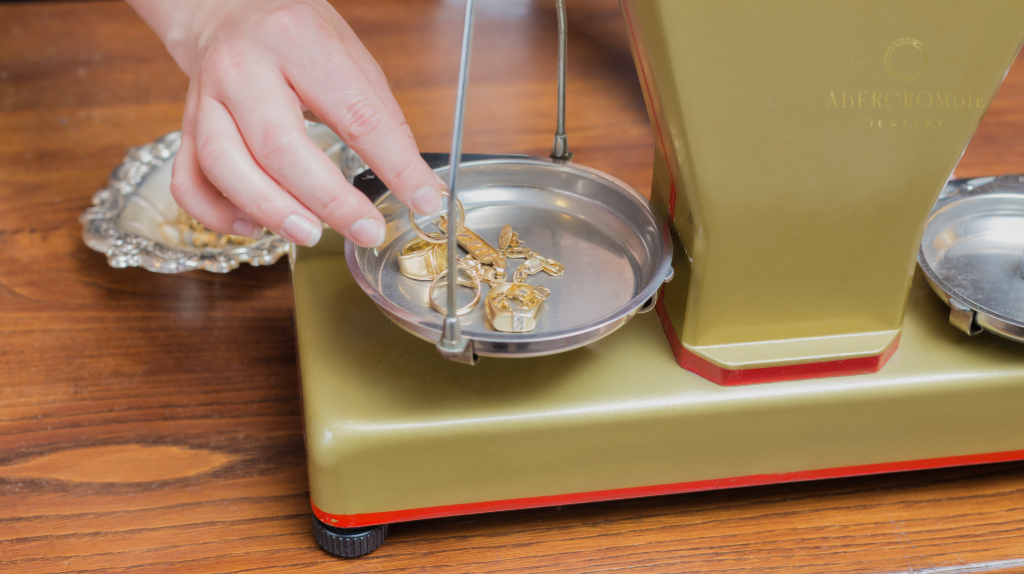
At our showroom, we weigh each piece on a precision scale and subtract the estimated stone weight before applying the spot price. We show you the calculation at each step and confirm you’re comfortable with the numbers before continuing.
Step 3: Check the Spot Price
The spot price of gold changes throughout every trading day, and we check it live before any calculation. Global commodity markets set it, and it’ll fluctuate throughout the day, with currency movements and demand. You can find it at any time on financial sites, commodity apps, or by searching for “gold spot price today.”
Spot price is typically quoted per troy ounce. To get the per-gram price, divide by 31.1. If gold is trading at $2,000 per troy ounce, the per-gram price is approximately $64.30.
The Calculation in Practice
A worked example makes this concrete. Suppose you have a 14K gold ring that weighs 5 grams.
Gold purity: 14K = 58.3% = 0.583
Pure gold content: 5 grams x 0.583 = 2.915 grams of pure gold
Spot price: assume 64.30 per gram (based on a 2,000 per troy ounce spot rate)
Pure gold value: 2.915 x 64.30 = approximately 187.50 in pure gold value
That’s the ring’s pure gold melt value, and it’s the number we use as our baseline. This is the starting point from which buyers make offers, though the actual offer can move above or below it. Most buyers offer a percentage of melt value based on their operating costs and margins. Specialist buyers like our Westlake evaluation team, who work from confirmed karat and live spot pricing, offer prices that are competitively above what generic cash-for-gold operations typically pay.
What Affects the Actual Offer
The melt value calculation is the floor, not the ceiling. Several factors move the offer above or below that baseline.
Buyer margins. Every buyer operates with some margin. The question is how large. Pawn shops and generic cash-for-gold operations typically offer 40 to 60 percent of melt value because they hold inventory for extended periods. Specialist jewelry buyers with higher volume and faster turnover can offer closer to the melt. Understanding this helps you evaluate any offer you receive, and we’re always happy to explain how our number was derived.
Form and condition. Scrap gold, broken chains, and single earrings are purchased at the melt. Intact, wearable pieces may command slightly above melt if a buyer can resell them in their current form. The distinction matters at the margins, and we factor it in when it’s relevant.
Period and collector value. This is where melt calculations can significantly undervalue a piece. A Victorian gold brooch, an Art Deco platinum ring, or a signed designer piece from a known house may be worth substantially more than its gold content to collectors. Our antique gold price specialists, who evaluate period pieces against collector demand rather than just melt value, catch premiums that a weight-and-karat calculation entirely misses.
Gold coins. Bullion coins like American Gold Eagles and Krugerrands are priced at or near spot for their gold content. Numismatic coins, which have collector premiums beyond their gold content, require separate evaluation. Our gold coin buyers, who assess both bullion and numismatic value, evaluate coin collections in the same appointment as jewelry.
Mixed Collections
Many clients bring mixed collections rather than single pieces. A typical estate lot might include 14K rings, 18K chains, and a 10K bracelet, along with silver pieces and costume jewelry. We evaluate each piece individually, sort by metal type, calculate each one separately, and present a combined offer with a per-category breakdown so you understand exactly what’s driving each number.
For mixed gold and platinum collections, our platinum-price buyers, who calculate platinum separately from gold using live platinum spot pricing, present both metal values before any offer is made.
For silver pieces mixed into a gold collection, our silver price buyers, who handle silver in the same appointment as gold, price each metal independently.
Why the Calculation Matters
Understanding how to calculate gold price protects you from two common outcomes: accepting an offer that’s too low because you didn’t know the baseline, and expecting more than the market supports because retail prices don’t reflect secondary market realities.
The melt calculation gives you the floor, and we think every seller should know it before accepting any offer. The actual offer should sit somewhere between that floor and the current market for the piece in its existing form. If an offer is significantly below the melt calculation, that’s a clear signal to get a second opinion.
For inherited gold collections where you need documentation of value for estate purposes, our gold estate buyers, who provide written assessments of collection value, can provide that documentation alongside a purchase offer.
For formal written appraisals for insurance or estate purposes, our gold price documentation, available by appointment at our Westlake showroom, is a separate paid service from the free verbal evaluation every client receives.